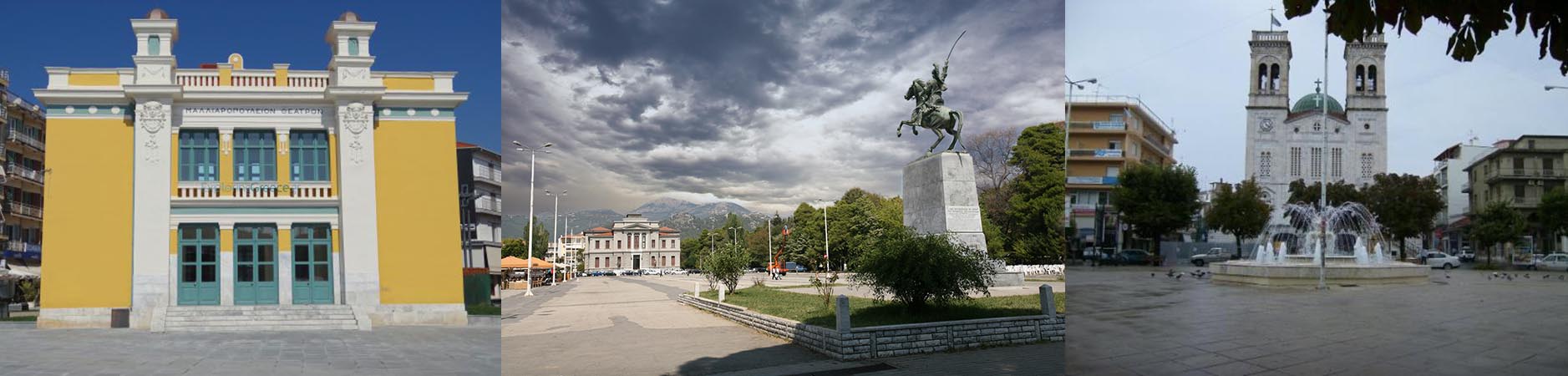
Tripolis, the capital of the district, built at approximately 650m in altitude and surrounded by the Arcadian mountains. In the Middle Ages the place was known as Drobolitsa, Droboltsá, or Dorboglitza, either from the Greek Hydropolitsa, 'Water City' or perhaps from the South Slavic for 'Plain of Oaks' The association made by 18th- and 19th-century scholars with the idea of the "three cities" (Τρίπολις, τρεις πόλεις "three cities" The Ottoman Turks referred to the town and the district as Tripoliçe.
The siege and the battle that took place on 23 September 1821, when it was released by the Turks, were determinant for the evolution of the revolution. Not even one place of the old city remained intact, just a few sporadic spots where parts of the walls or ruins can be seen. After the independent Greek state was established in 1830, Tripoli was rebuilt and was developed as one of the main cities of the Kingdom of Greece, serving as the capital of the Arcadia district. Every year, on this day, the liberation of the city is celebrated with a parade and traditional dances in Areos Square. During the 19th and the 20th centuries the city emerged to be the administrative, economic, commercial and transportation center of central and south Peloponnese. Tripolis’s location is such that you can view the surrounding mountains from almost every spot in town. These mountains, named by some as "Tripoli's balconets", summon you to expeditious and magical excursions in chapels, charming villages and rambles that always end up in good food with a breathtaking food!
Nothing Found
Apologies, but no results were found. Perhaps searching will help find a related post.
 English
 Ελληνικα